Embracing Fuzzy Thinking: Why Ambiguity Is a Superpower in a Black-and-White World

Updated: Oct 21, 2025
By DefiningU™
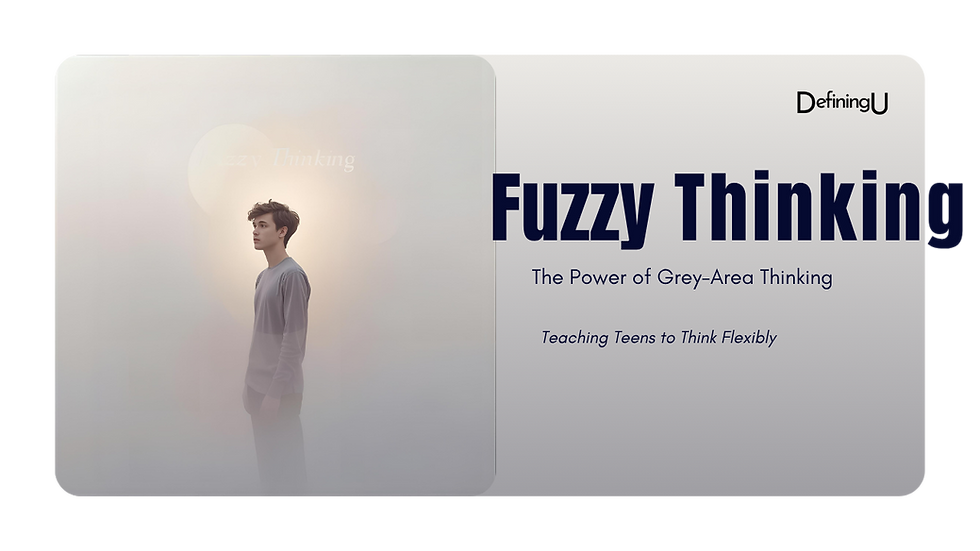
In a world obsessed with clear answers and clean categories, we tend to shy away from the grey areas. But what if fuzzy thinking, the ability to tolerate ambiguity, explore nuance, and sit with complexity, is actually one of the most valuable thinking skills we can cultivate?
At DefiningU™, we believe fuzzy thinking is not a weakness to fix; it’s a superpower to nurture, especially in young people growing up in a fast, filtered, and pressure-filled world.
What is Fuzzy Thinking?
Fuzzy thinking is the ability to:
Entertain multiple ideas at once
See contradictions without immediately resolving them
Sit with “I’m not sure yet” without anxiety
Hold off on categorising, judging, or finalising too quickly
It doesn’t mean being disorganised but being open-minded, flexible, and resilient to uncertainty.
For example:
A teen exploring career options can say, “I like both science and art, and I don’t have to decide just yet.”
A team member navigating a conflict says, “Both sides have valid points, let’s unpack it.”
A young adult choosing the next step says, “I’ll explore it before deciding if it’s right for me.”
This is fuzzy thinking in action: being okay with holding space for possibilities.
Why It’s Underdeveloped in Many Young People
From a young age, most systems reward clarity, correctness, and completion:
Is this answer right or wrong?
Pick a side.
You have 5 minutes to finish.
But life is not a worksheet. There are seasons of uncertainty. Messy emotions. Conflicting values. Multiple paths. Without fuzzy thinking, young people may:
Feel paralysed when choices aren’t clear
Default to extreme black-or-white views
Avoid complexity or discomfort altogether
And in adulthood, this can lead to impulsivity, rigidity, or anxiety when the real world doesn’t follow neat rules.
What It Looks Like in Real Life
A student says, “I feel two things at once, proud and scared, and that’s okay.
A young adult holds off on committing to a job offer while exploring what matters most.
A team reflects on a mistake without rushing to blame, but instead asking, “What’s the system behind this?
Fuzzy thinkers are often quietly powerful. They don’t rush. They reflect, reframe, and reconsider — and in doing so, they bring deeper insight to every situation.
How We Teach Fuzzy Thinking at DefiningU™
We create developmentally safe spaces where young people learn that:
Not having all the answers is okay
Exploring grey zones leads to deeper understanding
Some things need time before they make sense
Through:
Open-ended discussions with no “correct” outcome
Perspective-taking tasks where both sides hold truth
Visual analogies like mixing colours or weather patterns to explore in-between states
Journaling and reflection on complex emotional states
Fuzzy thinking builds cognitive flexibility, resilience, and self-awareness - critical ingredients for navigating adulthood, relationships, and career transitions.
Just to Summarise
Fuzzy thinking is not about being vague. It’s about being mentally agile. In a world of quick takes and rigid roles, we need more people who can pause and say: Let’s hold that question a little longer. Maybe it’s not either/or, maybe it’s both.
Let’s be okay with not knowing for now. Because sometimes, the clearest growth comes from leaning into the fog.
Want to help your teen or young adult build this skill?
🌐 Learn more at www.definingu.com.sg. Explore the DefiningU™ coaching experience for real-world thinkers.
Call/WhatsApp: +65 9115 8895
Important links
[fuzzy thinking] [flexible thinking skills] [cognitive flexibility] [youth coaching Singapore] [teen coaching Singapore] [executive function coaching] [critical thinking skills] [emotional resilience in teens] [decision-making for young adults] [Defining You Singapore]


Comments